


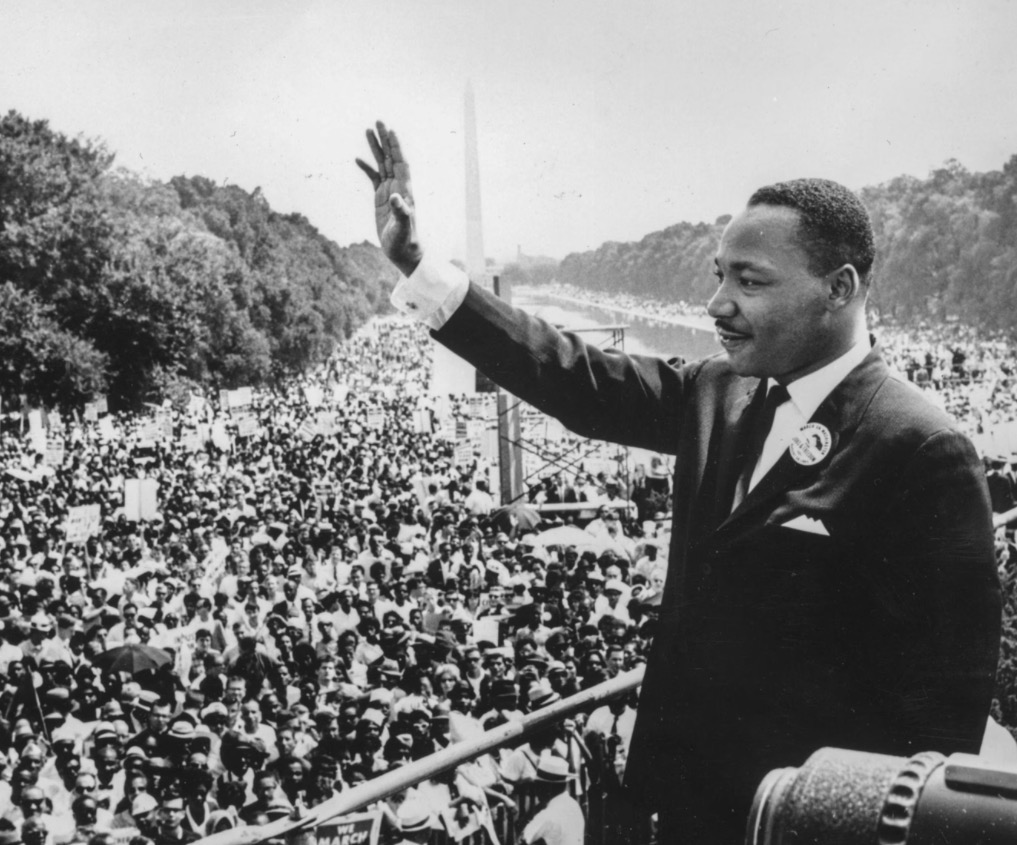
Every third Monday in January, we celebrate Martin Luther King Jr. Day. It is more than just a day off from school. It is a time to reflect on the life and legacy of a man who helped change the course of history. Dr. King was a leader of the Civil Rights Movement who fought for equality, justice, and freedom through peaceful protest and nonviolence. His belief that change could be achieved without hatred or violence continues to inspire people around the world.
Martin Luther King Jr. (MLK) was an African-American civil rights activist and Baptist minister who led the civil rights movement, fighting racial discrimination and segregation.
Born in Atlanta as Michael King Jr. on January 15, 1929, King grew up facing racism. As a black church leader, King led marches for the right to vote, desegregation, and other civil rights against the Jim Crow laws that had been affecting many African-Americans.
On December 1, 1955, in Montgomery, Alabama, when he learned about Rosa Parks getting arrested for refusing to give up a seat to a white man on the city bus, King began to lead the Montgomery Bus Boycott, which led him to be arrested several times himself, and his house was bombed.
One of Dr. King’s most powerful contributions to the Civil Rights Movement was his ability to unite people through words and action. His famous speech, “I Have a Dream,” challenged America to confront racism and imagine a future built on equality and understanding. However, his work went far beyond one speech. Dr. King organized marches, led boycotts, and risked his life to stand up against injustice, proving that courage and compassion can coexist.
On August 28, 1963, King gave his “I Have A Dream” speech in front of the Lincoln Memorial in Washington, D.C., during the March on Washington for Jobs and Freedom. The march was successful and created new demands: ending racial segregation in public schools; ending racial discrimination in employment; protecting civil rights workers from police brutality; a $2 minimum wage for all workers; and self-government for Washington, D.C.
Over the next few years, King led many of the protests and marches to decry racism, including the March from Selma to Montgomery in 1965, and opposing the Vietnam War. In 1968, King traveled to Memphis, Tennessee, to support black sanitation workers, who had been on strike for better treatment and higher wages. On April 3, King delivers his “I’ve Been to the Mountaintop” address at the Mason Temple. Little did he know that this day would be the calm before the storm.
The next day, on April 4, 1968, King was shot and killed on the second-floor balcony of the Lorraine Motel at 6 pm. An hour later, King was pronounced dead at St. Joseph’s Hospital. His death outraged everyone and started race riots in many U.S. cities.
The federal holiday of MLK Day was established in 1971 and observed for the first time in 1986. The memorial of MLK on the National Mall in Washington, D.C. was dedicated in 2011.
Dr. King’s message is still relevant today. Issues of inequality and discrimination have not disappeared, and his call for justice reminds us that progress requires effort from everyone. As students, we honor his legacy not only by remembering his words, but by practicing kindness, standing up for others, and promoting fairness in our school and community.
Martin Luther King Jr. Day serves as a reminder that change begins with individuals who are willing to speak up and act. By carrying his values forward, we help keep his dream alive.
![The new leadership at Dinuba Intermediate School (from left to right): Jessica Juarez (soon to be Jessica Chavez) - Learning Director, Rosa Carreon - Counselor, Hilda Osorio - Counselor, Gloria Valencia - Principal, and Micah Hiett - Learning Director. [Photo courtesy of Gloria Valencia]](https://emperorgrapevine.com/wp-content/uploads/2026/05/682710295_18557787079066828_5882969838312812831_n-900x1200.jpg)


